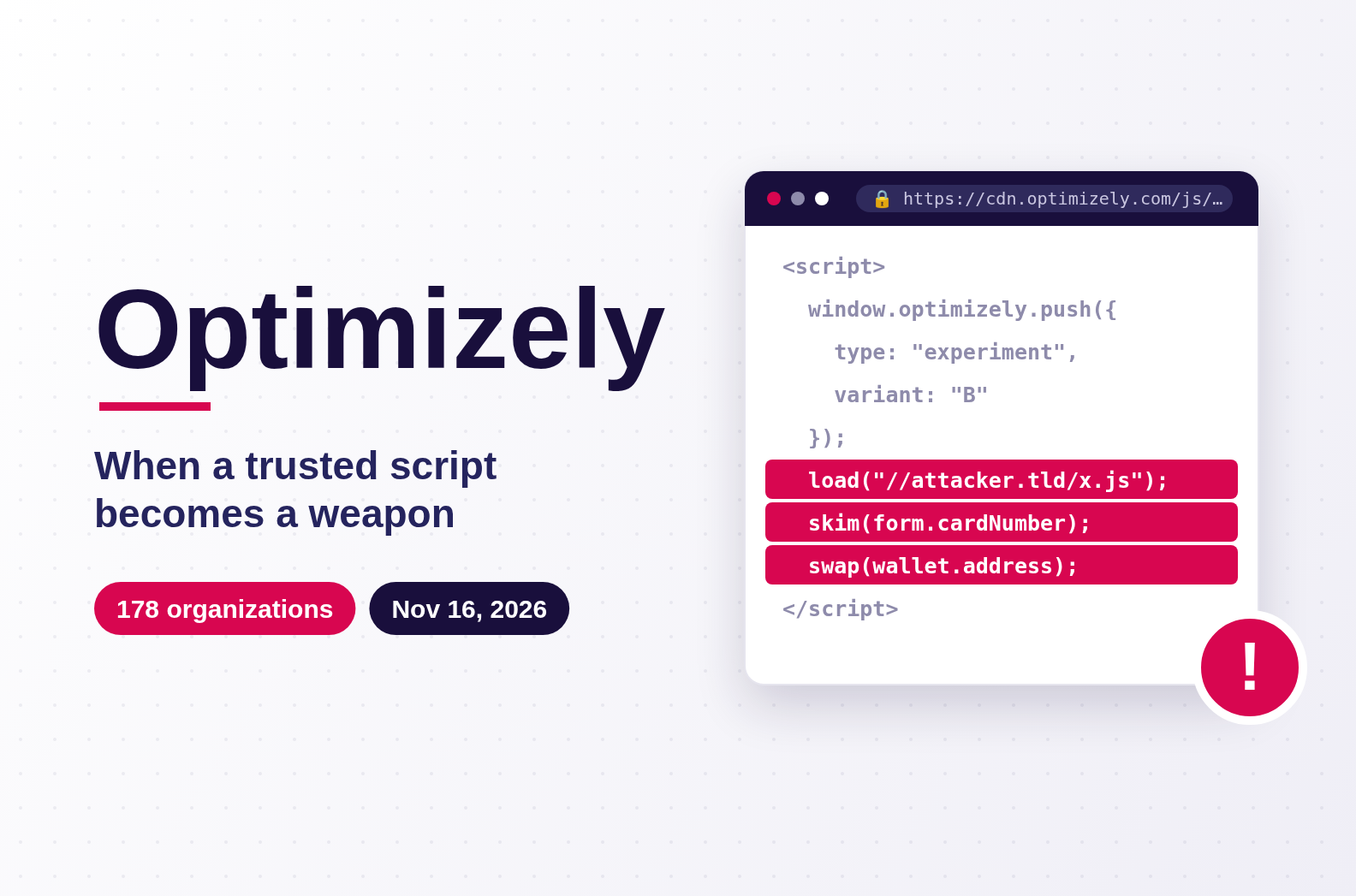
On November 16, 2026, an attack targeting the Optimizely Web Experimentation platform made it possible to inject malicious JavaScript code into the websites of major international organizations, including Salesforce, BBC, CNN, Zoom, GitLab and Air France-KLM. This incident highlights an often underestimated issue: the security of a website depends not only on its own code, but also on that of its suppliers.
An attack that does not require compromising the targeted companies
On November 16, 2026, cybersecurity researchers at Report URI identified a compromise campaign affecting several major organizations using the Optimizely platform.
Out of 1,611 JavaScript files analyzed, 188 contained malicious code, linked to 178 distinct organizations. The final toll could be higher, as the researchers were unable to examine every script distributed by the service. The organizations identified operate in a wide range of sectors: banking, insurance, air transport, retail, healthcare and digital services.
The Optimizely attack in numbers
Figures reported by Report URI researchers as of November 16, 2026
1,611
scripts analyzed
Optimizely JavaScript files reviewed
188
booby-trapped scripts
Containing a malicious loader
178
organizations
Banking, airlines, retail, healthcare…
$7,000
stolen
In cryptocurrency
Source: Report URI and Optimizely incident report of November 17, 2026
What makes this attack stand out is its modus operandi. The attackers did not need to break directly into the infrastructure of the companies concerned. They exploited a vulnerability at a supplier those companies rely on, turning a legitimate service into a vector for distributing malicious code.
This is a software supply chain attack, whose consequences materialize directly in internet users’ browsers.
How did the attackers exploit Optimizely?
Optimizely Web Experimentation is a solution used to run A/B tests, personalize interfaces and improve the user experience of websites. To work, it relies in particular on JavaScript files hosted by Optimizely and loaded automatically when a visitor views a page.
These scripts can include custom code, called Project JavaScript, configured from the platform’s administration interface. This is the feature that was hijacked.
According to the incident report published by Optimizely on November 17, the attackers exploited a flaw in the Web Experimentation account creation process. This vulnerability allowed them to impersonate administrator users of certain customer accounts, without needing to know their passwords.
They then modified the JavaScript code associated with the affected projects to insert a malicious loader.
The distribution mechanism in 4 steps
From a hijacked customer account to the visitor’s browser
1
Hijacking administrator privileges
Exploitation of a vulnerability allowing the attackers to act on behalf of highly privileged users. This type of weakness is a reminder of the importance of regularly carrying out application security testing.
2
Code injection
Modification of the custom JavaScript of Optimizely projects.
3
Legitimate distribution
The modified script is loaded from Optimizely’s usual infrastructure, including the cdn.optimizely.com domain.
4
Execution in the browser
The malicious code runs when an affected page is viewed, then attempts to load additional components from attacker-controlled domains.
Source: Optimizely incident report of November 17, 2026
A scanner such as HTTPCS Security can search web applications for exploitable vulnerabilities, particularly those likely to lead to unauthorized access or compromise. Its authenticated scanning capability also makes it possible to explore the features available to logged-in users, depending on the scope and permissions provided.
The script was still served from a legitimate domain, protected by HTTPS with a valid TLS certificate.
This is precisely what makes the attack noteworthy: a secure HTTPS connection guarantees the integrity of the transport, but not the harmlessness of the code delivered by the supplier.
The browser was simply running a script the website had explicitly asked it to load.
Payment card theft, cryptocurrency hijacking and iOS exploitation
Analysis of the malicious scripts revealed several offensive capabilities, some of which evolved over the course of November 16.
Three malicious payloads identified
Capabilities observed in the code injected via Optimizely
💳
Web skimming
Interception of card numbers, expiry dates and security codes entered in forms
Magecart-style
🪙
Crypto-clipper
Replacement of wallet addresses in pages, forms and copy-paste operations
≈ $7,000 stolen
📱
iOS exploits
Loading of modules targeting iPhone and iPad, especially older iOS versions
Coruna, DarkSword
Source: Report URI technical analysis, November 16, 2026
Interception of payment card data
Part of the code sought to identify payment card data entered in forms: card number, expiry date and card security code.
This technique, known as web skimming, consists of capturing information directly in the browser, before or during its transmission to the legitimate server.
The code could monitor form submissions and certain HTTP requests made in JavaScript.
This modus operandi is reminiscent of Magecart attacks, which rely on injecting malicious JavaScript to intercept sensitive data, particularly on e-commerce websites.
This is precisely one of the threat scenarios covered by web integrity monitoring. By tracking changes to JavaScript files, including those loaded from external suppliers, HTTPCS Integrity can spot suspicious changes that may reveal an attempt to inject malicious code. The solution makes it easier to identify a change and compare it with a previously analyzed version.
This monitoring helps detect tampering with web resources, but cannot on its own guarantee that all data exfiltration will be prevented.
Data entered in isolated payment interfaces, such as iframes hosted by certain payment providers, did however benefit from additional protection thanks to browsers’ same-origin policy.
Hijacking of cryptocurrency transactions
The attackers had also built a mechanism to detect cryptocurrency wallet addresses and replace them with their own.
This replacement could occur in page content, forms and certain copy-paste operations. Report URI researchers identified around $7,000 in transactions to wallets linked to the attack on November 16. This amount does not necessarily represent the total loss.
Attempts to exploit iOS devices
Finally, the researchers observed additional components being loaded that targeted iPhone and iPad devices, particularly older versions of iOS.
Exploit chains known as Coruna and DarkSword were identified in the technical analysis. However, the capabilities of the malicious code should be distinguished from their actual results. At this stage, public information does not make it possible to determine how many devices were actually compromised or the extent of any payment data exfiltrated.
The real problem: the trust placed in third-party components
The Optimizely incident highlights a structural weakness in many web applications: their reliance on external resources over which IT teams do not always have sufficient visibility.
Today, a website can load dozens of components from different suppliers: marketing tools, consent managers, JavaScript libraries, audience analytics solutions and support interfaces.
These resources help applications run, but they also widen their attack surface. Unlike a library bundled and frozen within a development cycle, an external JavaScript file can change independently of the company’s production releases.
A change made by the supplier can therefore be executed in visitors’ browsers without any prior change to the application code hosted by the organization.
Yet when a third-party script has execution rights on a page, it can potentially interact with its content, access certain data and make network requests.
A website can therefore be properly secured on the server side while exposing its users to malicious code running in the browser.
This is also why security audits and one-off penetration tests, while essential, are not always enough to cover this threat.
An audit carried out before a supplier is compromised cannot, on its own, detect a malicious change made several weeks later.
On the other hand, an application security and code audit carried out by ZIWIT can examine how external dependencies are integrated, how permissions are managed, sensitive functions and security configurations. These checks are essential to identify weaknesses that could make it easier to exploit a compromised component or worsen its consequences.
The question is therefore no longer just whether applications have vulnerabilities, but also whether the components they run have been tampered with.
How does HTTPCS Integrity help monitor third-party scripts?
Detecting unexpected changes is a complementary lever for reducing this risk.
This is the purpose of HTTPCS Integrity, the website and web application integrity monitoring solution developed by ZIWIT.
With its File Integrity Monitoring (FIM) features, HTTPCS Integrity maps a website’s resources and monitors changes affecting its internal content, as well as its external resources, including JavaScript files, CSS stylesheets and other components loaded from third-party infrastructure.
The solution identifies changes observed between scans, displays the modifications and triggers alerts when potentially dangerous tampering is detected. It can also monitor certain fraudulent redirects that malicious scripts may cause.
A three-layer defense
Complementary controls, from development to production
① Development
Application security audit and code review
② Regular testing
DAST scans and security header checks with HTTPCS Security
③ Production
Integrity monitoring of internal and third-party scripts with HTTPCS Integrity
In a scenario similar to Optimizely’s, this monitoring can help identify an unexpected change to JavaScript served by a supplier, independently of any update made by internal teams.
This approach makes investigation easier and shortens detection time. It does not, however, replace browser blocking mechanisms or application security controls: its effectiveness depends in particular on the resources actually analyzed and the configured monitoring frequency.
The value therefore lies in combining security controls during development, technical audits and integrity monitoring in production.
What measures should CIOs and CISOs take?
Beyond the Optimizely incident, several measures can strengthen application security against compromised third-party components.
6 measures against compromised third-party scripts
Priorities for CIOs and CISOs
01
Map
External JavaScript dependencies
02
Restrict
With a Content Security Policy
03
Verify
Resource integrity (SRI)
04
Monitor
Third-party scripts through the SOC
05
Scan
For vulnerabilities continuously (DAST)
06
Prepare
Supplier incident response
1. Map external dependencies
Identify the JavaScript resources running on exposed applications, their suppliers and the pages where they are used. Authentication flows, customer areas and payment interfaces deserve particular attention.
This mapping should also include components added by marketing teams or service providers, particularly through tag managers. Their integration sometimes bypasses development teams’ usual approval processes.
2. Implement a Content Security Policy (CSP)
A CSP controls the sources from which browsers can load resources and, depending on the configuration, the destinations to which they can send data.
In the Optimizely case, a restrictive policy could have prevented the secondary malicious code from loading from unauthorized domains. CSP is not a universal protection, however: a malicious script already allowed to run may retain some ability to interact with the page.
The script-src, connect-src and frame-src directives must therefore be configured carefully. Overly permissive settings, such as unsafe-inline, unsafe-eval or excessively broad domain lists, can limit the effectiveness of these protections.
Implementing a CSP should also go hand in hand with regular checks of HTTP security headers and application configurations.
These checks identify missing, incomplete or misconfigured security policies that could increase an application’s exposure.
Beyond detecting exploitable flaws, HTTPCS Security also analyzes the security settings and configuration warnings of websites. This approach helps identify issues related to HTTP security headers and complements vulnerability scans with hardening recommendations.
These checks do not, however, replace a review of the CSP tailored to how the application actually works.
3. Check resource integrity
Where technically possible, Subresource Integrity (SRI) allows the browser to verify that an external resource matches an expected cryptographic hash.
However, it can be restrictive for scripts that suppliers update frequently.
Change monitoring therefore remains necessary, particularly for components with dynamic content.
4. Include third-party scripts in security monitoring
Application monitoring should not be limited to service availability or server log analysis.
It is also worth tracking changes to JavaScript resources, the appearance of new dependencies and suspicious connections initiated from browsers.
CSP reports and client-side monitoring tools can provide additional information about attempts to load unauthorized resources.
This information becomes more valuable when it is integrated into incident detection and triage processes.
A managed SOC, such as the one offered by ZIWIT, can support this approach by analyzing security events, correlating them with other available signals and assisting with response actions.
Such monitoring does, however, require the right data sources: events observed only in the browser are not automatically visible in SIEM logs.
5. Complement monitoring with continuous vulnerability scanning
The Optimizely case also shows the importance of distinguishing between two risks: the exploitation of a vulnerability in the application and the malicious modification of an external resource. These risks are different and require complementary detection mechanisms.
DAST (Dynamic Application Security Testing) scans look for exploitable vulnerabilities in running applications.
As part of this approach, HTTPCS Security performs automated scans of websites and applications to identify security vulnerabilities and facilitate their remediation.
These scans do not replace third-party script monitoring, but they help reduce overall application risk, particularly when combined with manual audits and integrity checks.
6. Plan a supplier incident response procedure
If an external dependency is compromised, the organization must be able to quickly identify the affected applications, temporarily disable the component if necessary and determine which data may have been exposed. This requires coordination between development, operations and cybersecurity teams and suppliers.
Organizations using Optimizely Web Experimentation are encouraged to review their logs and security events for the exposure period of November 16, 2026.
Incident timeline
November 16, hour by hour
Nov 16, 2026 · 07:51 UTC
First malicious code injection
The Project JavaScript of hijacked customer accounts is modified to insert a malicious loader.
Nov 16, 2026 · throughout the day
The payloads evolve
Web skimming, cryptocurrency hijacking, then modules targeting iPhone and iPad.
Nov 16, 2026
Report URI identifies the campaign
188 booby-trapped scripts out of 1,611 analyzed, linked to 178 organizations.
Nov 16, 2026 · 22:24 UTC
All identified injections removed
End of the exposure window to review in your logs: about 14.5 hours.
Nov 17, 2026
Optimizely publishes its incident report
Vulnerability fixed, list of malicious domains and recommendations for customers.
Today
The investigation continues
The number of compromised devices and the extent of exfiltrated data remain unknown.
Source: Optimizely incident report of November 17, 2026 and Report URI
The supplier’s report states that the first malicious code was injected at 07:51 UTC and that all identified injections had been removed by 22:24 UTC. It also recommends reviewing pages containing payment forms, retaining logs and analyzing network requests to the malicious domains listed in its security advisory.
The investigation should focus on the potential consequences of the script’s execution, not just on confirming its removal.
If a compromise or data exfiltration is suspected, ZIWIT’s incident response and digital forensics teams can support organizations with technical analysis, evidence preservation and remediation measures.
Conclusion: monitor what you run, not just what you develop
Optimizely has confirmed that it fixed the exploited vulnerability and removed the injected code from the affected projects on November 16, 2026. The investigation into the consequences of the incident is ongoing.
The significance of this attack nevertheless goes beyond the specific case of the platform.
It is a reminder that a web application’s security does not stop at the boundaries of its infrastructure. Resources loaded from third-party services are an integral part of how it works and must, as such, be included in its security strategy.
For CIOs and CISOs, the challenge is to complement traditional controls with precise knowledge of dependencies, appropriate restriction mechanisms and monitoring of their integrity over time.
Trusting a supplier is often necessary. Assuming its code will always remain reliable should never be a security prerequisite.